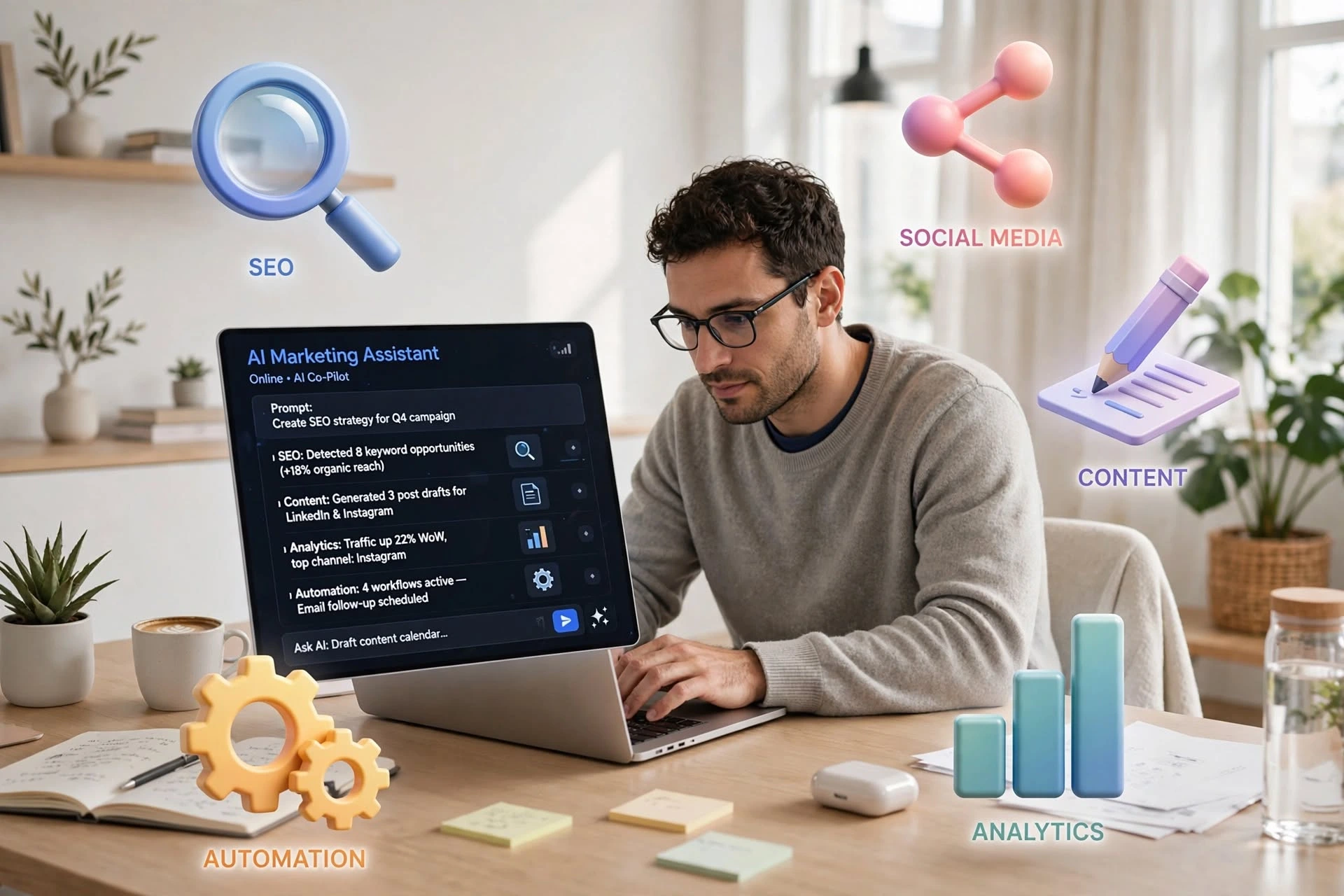
Marketing has changed a lot, and Best AI Tools for Marketers can make everyday marketing tasks faster and easier. Marketers now need to create content, manage social media, improve SEO, analyze data, run ad campaigns, and communicate with customers—all while saving time.
This is where AI can make a real difference. AI tools can help with everything from writing blog posts and creating social media captions to finding keywords, designing graphics, analyzing campaigns, and automating repetitive tasks.
There are hundreds of AI marketing tools available today, so choosing the right ones can be confusing. In this guide, we’ll explore some of the best AI tools for marketers, what they can do, and how they can help you work smarter.
Best AI Tools for Marketers: Quick List
Here are our top picks:
- ChatGPT – Best for content, ideas, research, and marketing tasks
- Jasper – Best for marketing content and brand voice
- Canva – Best for social media graphics and visual content
- Semrush – Best for SEO and keyword research
- HubSpot – Best for CRM and marketing automation
- Copy.ai – Best for marketing copy and sales content
- Surfer SEO – Best for content optimization
- Descript – Best for video and podcast content
- Zapier – Best for marketing automation
- Synthesia – Best for AI video creation
AI marketing tools are increasingly being used for content creation, SEO, analytics, automation, and customer engagement.
What Are the Best AI Tools for Marketers?
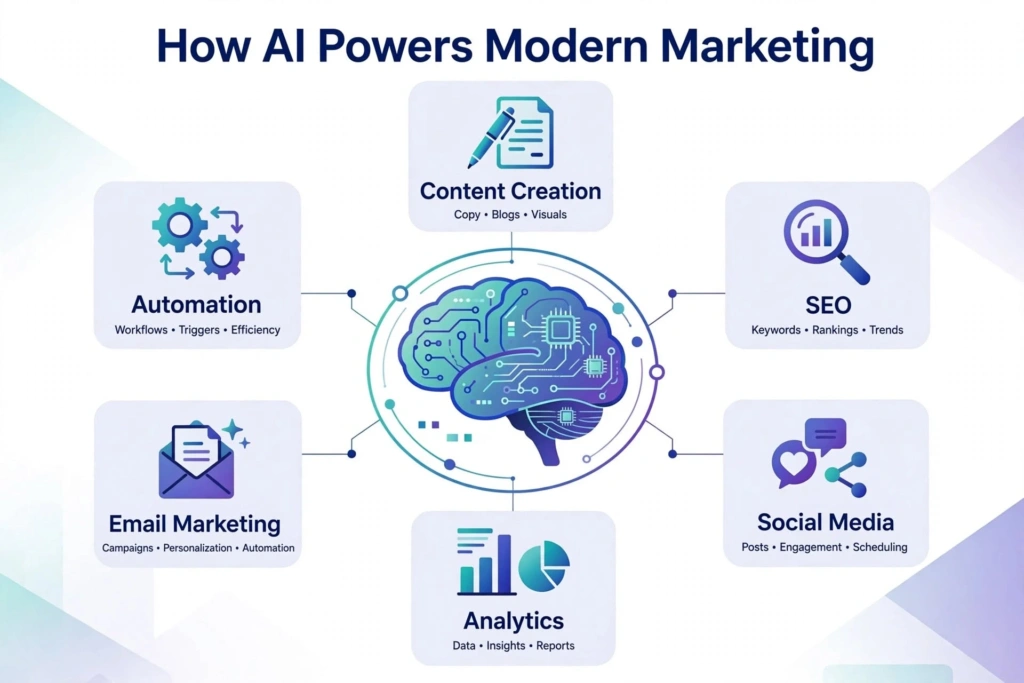
AI tools for marketers are software applications that use artificial intelligence to help with common marketing activities.
Depending on the tool, AI can help you:
- Generate content ideas
- Write and edit marketing copy
- Research keywords
- Create social media posts
- Design images and graphics
- Analyze marketing data
- Create videos
- Automate repetitive tasks
- Personalize customer communication
- Improve SEO
- Generate campaign ideas
Instead of spending hours starting every task from scratch, marketers can use AI to create a first draft, analyze information, or automate part of a workflow.
However, AI-generated content should still be reviewed by a human. Good marketing needs creativity, experience, brand understanding, and judgment.
1. ChatGPT – One of the Best AI Tools for Marketers

OpenAI’s ChatGPT is one of the most versatile AI tools a marketer can use.
It can help with brainstorming, content planning, blog outlines, email drafts, social media captions, customer personas, ad copy, research, and data analysis.
For example, a marketer can give ChatGPT a product description and ask it to create:
- Facebook ad variations
- Instagram captions
- Email subject lines
- Blog ideas
- Landing page copy
- Video scripts
ChatGPT can also work with connected marketing tools and data sources in supported business workflows.
Best for: Content creation, brainstorming, research, campaign planning, and everyday marketing tasks.
Why marketers should use it: It can handle many different marketing tasks from one place.
2. Jasper – Best AI Marketing Content Creation
Jasper is built specifically around marketing and content workflows.
It can help businesses create marketing content while maintaining a consistent brand voice. This can be useful for agencies and marketing teams that produce large amounts of content.
Jasper also focuses on marketing workflows, brand controls, SEO, research, and content production.
Best for: Marketing teams, agencies, and businesses that need brand-focused content.
Why marketers should use it: It can make large-scale content production more organized and consistent.
3. Canva – Best AI Tool for Visual Marketing
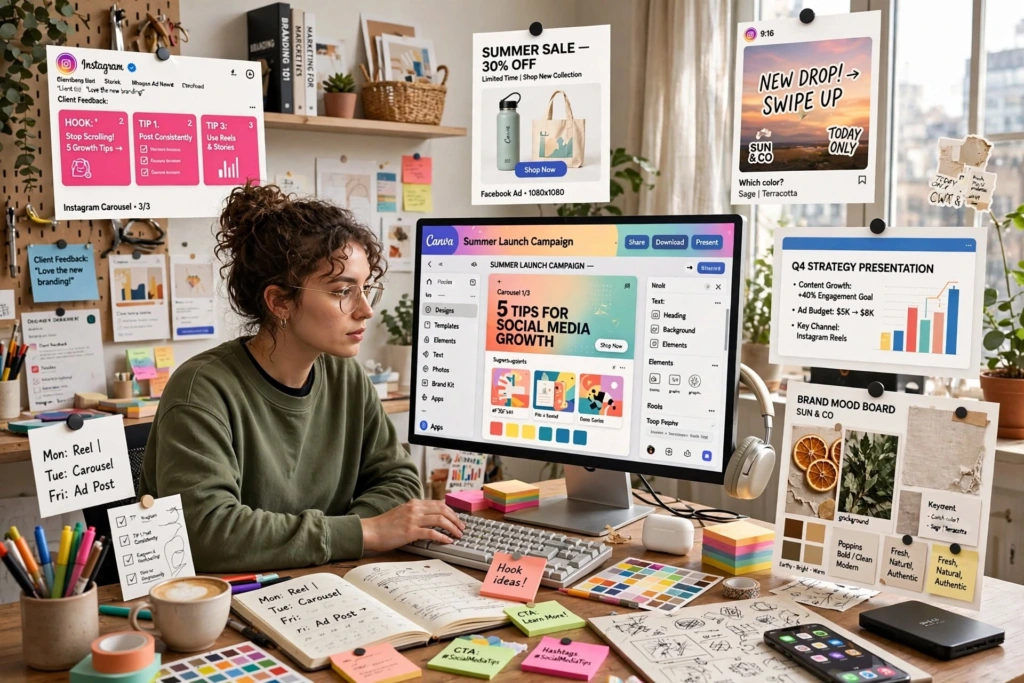
Canva is a popular choice for marketers who need professional-looking designs without being professional graphic designers.
Its AI features can help create and modify marketing visuals, social media posts, presentations, advertisements, and other creative assets.
Canva’s AI marketing features are particularly useful for content creation and visual campaigns.
You can use Canva to create:
- Instagram posts
- Facebook graphics
- YouTube thumbnails
- Blog images
- Presentations
- Advertisements
- Posters
- Infographics
Best for: Social media marketers, small businesses, bloggers, and content creators.
Why marketers should use it: It makes visual content creation much faster.
4. Semrush – Best AI SEO Tool for Marketers
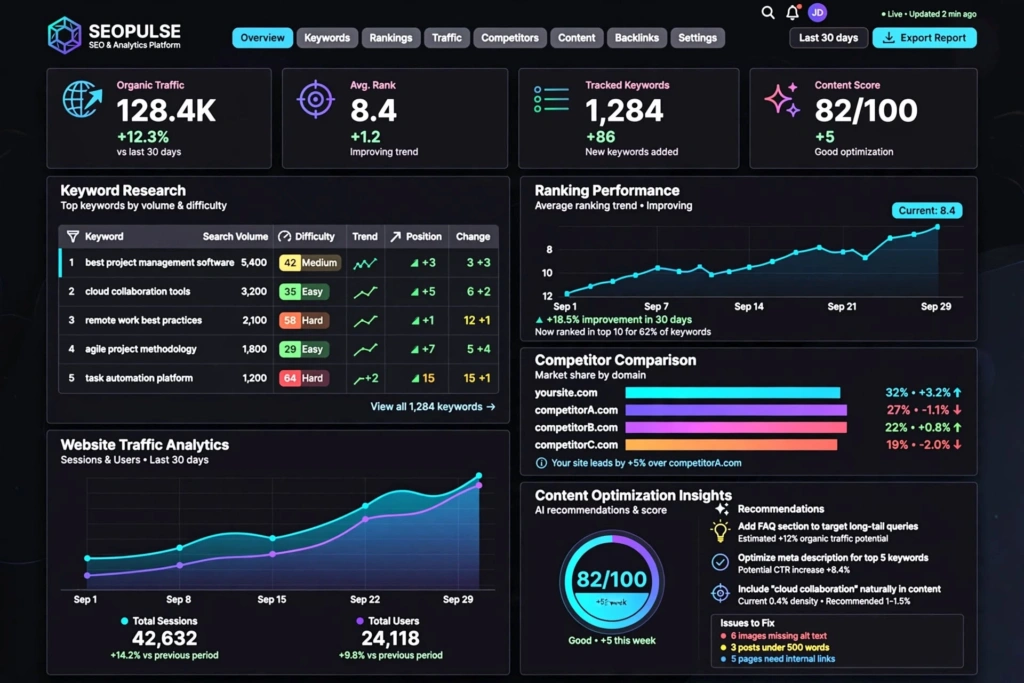
Semrush is a powerful platform for marketers who depend on organic search traffic.
SEO involves much more than simply finding keywords. Marketers also need to understand competitors, search intent, content opportunities, backlinks, website performance, and search visibility.
Semrush can help marketers research keywords, analyze competitors, monitor rankings, and improve their SEO strategy.
AI-powered SEO tools are increasingly being used for keyword targeting, content audits, competitive analysis, and optimization.
Best for: SEO professionals, bloggers, agencies, and businesses that want more organic traffic.
Why marketers should use it: It brings many SEO research and optimization features together in one platform.
5. HubSpot – Best AI Marketing Automation
HubSpot combines marketing, CRM, sales, customer service, and automation features.
Its AI-powered marketing tools can help businesses attract visitors, generate leads, personalize customer experiences, and manage campaigns.
HubSpot also offers AI features for campaign analysis and customer-related workflows.
For marketers, this can be useful for:
- Lead generation
- Email marketing
- Customer segmentation
- Campaign management
- CRM activities
- Reporting
- Marketing automation
Best for: Growing businesses and marketing teams.
Why marketers should use it: It connects marketing activities with customer and sales data.
6. Copy.ai – Best AI Tool for Marketing Copy
Copy.ai is designed to help marketers produce written content more quickly.
You can use it for social media copy, product descriptions, sales messages, email content, website copy, and other marketing materials.
Instead of staring at a blank page, marketers can use AI to create an initial version and then improve it with their own ideas and brand knowledge.
Best for: Copywriters, social media managers, sales teams, and content marketers.
Why marketers should use it: It can speed up repetitive copywriting tasks.
7. Surfer SEO – Best AI Content Optimization Tool
Creating content is only one part of SEO. You also need to make sure the content is useful, well-structured, and properly optimized for the target search query.
Surfer SEO focuses on content optimization and can help marketers analyze search results and improve content based on SEO-related recommendations.
AI-powered SEO platforms can reduce some of the manual work involved in content audits, optimization, and competitive analysis.
Best for: Bloggers, SEO writers, agencies, and content marketing teams.
Why marketers should use it: It can provide practical optimization suggestions while you work on content.
8. Descript – Best AI Tool for Video Marketing
Video has become an important part of digital marketing, but editing videos can take a lot of time.
Descript makes video and audio editing easier by allowing creators to work with transcripts and edit content in a more text-based way.
Marketers can use it to create:
- Short-form videos
- Podcasts
- YouTube content
- Interviews
- Marketing clips
- Social media videos
Best for: Video marketers, podcasters, YouTubers, and content creators.
Why marketers should use it: It simplifies editing and content repurposing.
9. Zapier – Best AI Marketing Automation Tool
Many marketing tasks are repetitive.
For example, you may need to:
- Receive a new lead.
- Add the lead to your CRM.
- Send an email.
- Notify your sales team.
- Add the information to a spreadsheet.
Automation tools such as Zapier can connect different applications and reduce manual work.
This means marketers can spend less time moving information between tools and more time working on strategy.
Best for: Marketing teams, agencies, freelancers, and businesses with repetitive workflows.
Why marketers should use it: It connects different marketing applications and automates routine tasks.
10. Synthesia – Best AI Video Creation for Marketers
Synthesia is an AI video platform that can help businesses create videos using AI presenters and generated voiceovers.
This can be useful when marketers need training videos, product explainers, internal communication videos, or promotional content without organizing a traditional video shoot.
Best for: Businesses, training teams, agencies, and marketers creating professional videos at scale.
Why marketers should use it: It can reduce the time and resources needed for certain types of video production.
How AI Marketing Tools Can Help Marketers
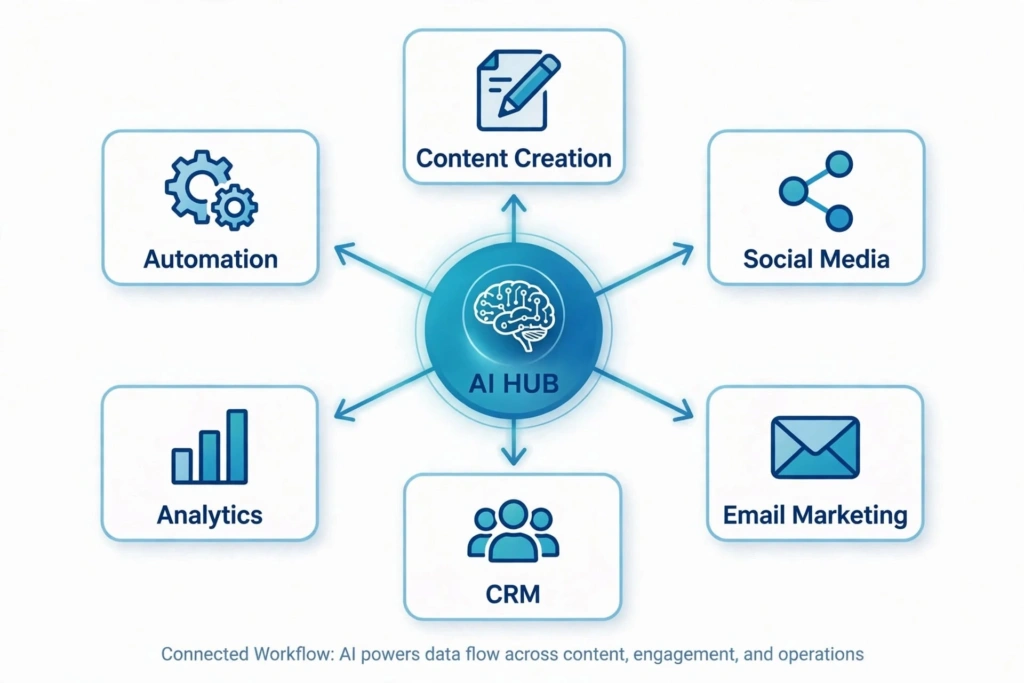
AI can be useful at almost every stage of a marketing campaign.
AI for Content Marketing
AI can help marketers brainstorm topics, create outlines, draft articles, write social media posts, and repurpose existing content.
However, marketers should always add their own experience and insights. AI should be treated as an assistant rather than a replacement for original thinking.
AI for SEO and Keyword Research
AI can help with keyword research, content optimization, competitor analysis, content briefs, and identifying opportunities.
SEO tools such as Semrush and Surfer SEO can make many of these tasks easier.
AI for Social Media Marketing
Marketers can use AI to generate content ideas, captions, hooks, scripts, and visual concept
For example, one blog post can be turned into several social media posts instead of creating every post from scratch.
AI for Email Marketing
AI can help marketers write subject lines, email drafts, follow-up messages, and different versions of campaigns for different audiences.
This can make email marketing faster while still allowing marketers to review and personalize the final message.
AI for Advertising
AI can help generate different ad headlines, descriptions, creative ideas, and audience variations.
The important thing is to test the results instead of assuming that the AI-generated version will automatically perform better.
How to Choose the Best AI Marketing Tool
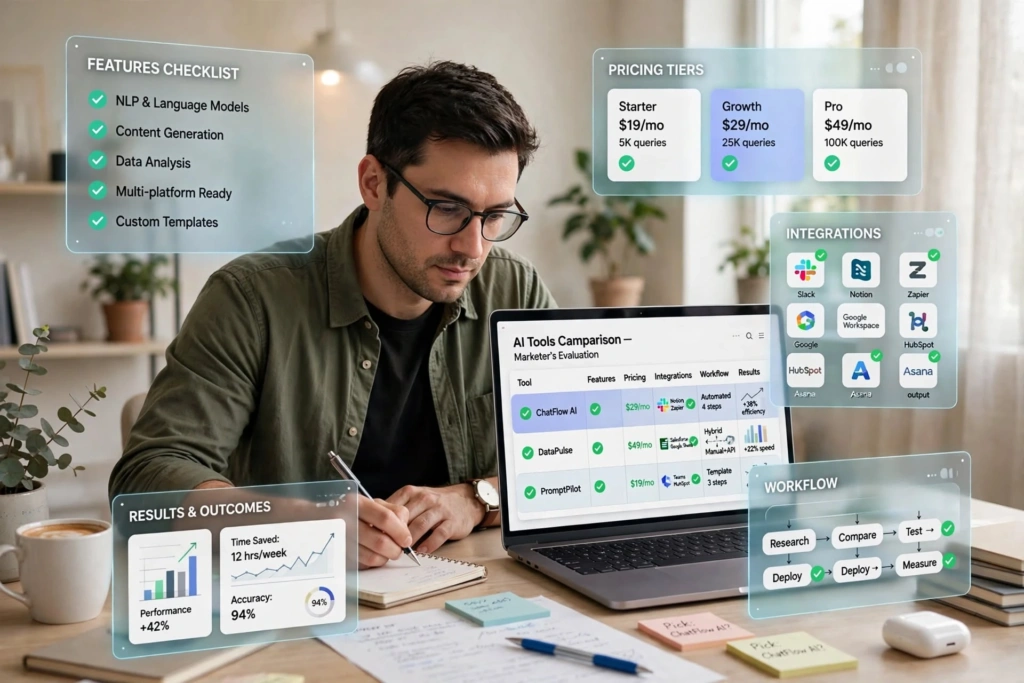
You don’t need every AI tool available.
In fact, using too many tools can make your workflow more complicated and expensive.
Before choosing an AI marketing tool, ask yourself:
1. What problem does it solve?
Don’t choose a tool simply because it is popular. Choose one that solves a real problem in your marketing workflow.
2. Does it fit your workflow?
A good tool should make your work easier rather than create another complicated process.
3. Does it integrate with your existing tools?
Check whether it works with the platforms you already use, such as WordPress, Google Analytics, CRM software, email platforms, or social media tools.
4. Is the output actually useful?
AI-generated content still needs human review. Test the quality before depending on a tool for important campaigns.
5. Does the cost make sense?
Start with the tools that provide the biggest benefit. You may find that three well-chosen tools are more useful than ten different subscriptions.
Are AI Tools Replacing Marketers?
Not really.
AI can automate certain tasks, but marketing is still about understanding people.
A successful marketer needs to understand:
- Customer needs
- Brand positioning
- Audience behavior
- Creativity
- Market trends
- Business goals
- Campaign performance
AI can help with research, content, analysis, and repetitive work, but humans still need to make important decisions.
The best approach is to use AI as a marketing assistant, not as a complete replacement for your marketing team.
Final Thoughts on the Best AI Tools for Marketers

The best AI tools for marketers are not necessarily the tools with the most features. The right tool is the one that solves a real problem and fits naturally into your workflow.
For most marketers, a useful starting combination could be ChatGPT for ideas and content, Canva for design, Semrush for SEO, and an automation or CRM platform such as HubSpot or Zapier.
You don’t need to adopt everything at once. Start with one or two tools, learn how they fit into your workflow, and then expand your AI marketing stack when you actually need additional capabilities.
AI can save marketers time, but the real advantage comes from combining AI’s speed with human creativity, strategy, and judgment.