
Starting a business can be exciting, but managing everything with a small team can be challenging. The best AI tools for startups can help founders save time, automate repetitive tasks, create better content, and stay organized. From writing and marketing to customer support and coding, AI tools can make everyday work easier and help startups focus more on growing their business.
In this guide, we’ll explore some of the best AI tools for startups and explain how they can help you work smarter without adding unnecessary complexity to your workflow.
Best AI Tools for Startups: Quick List

| AI Tool | Best For |
|---|---|
| ChatGPT | Writing, research, brainstorming and business tasks |
| Claude | Long documents and detailed analysis |
| Canva | Graphics, presentations and marketing |
| Notion AI | Notes, documentation and team organization |
| Zapier | Workflow automation |
| HubSpot | CRM, sales and marketing |
| Cursor | AI-assisted coding |
| Grammarly | Writing and communication |
| Perplexity | Research and information gathering |
| Otter.ai | Meeting transcription and notes |
| Jasper | Marketing content |
| ClickUp | Project management and productivity |
1. Best AI Tools for Startups: ChatGPT

OpenAI’s ChatGPT is one of the most versatile AI tools a startup can use.
A founder can use it for everything from brainstorming a business idea to writing emails, creating marketing content, analyzing information, preparing documents, and generating code.
For example, you can ask ChatGPT to:
- Create a business plan
- Write website content
- Generate social media ideas
- Draft customer emails
- Summarize documents
- Brainstorm product features
- Create marketing strategies
- Explain technical concepts
- Help with coding
For teams, ChatGPT Business provides a shared workspace with collaboration, administration and business-oriented features.
Best for: Founders, marketers, developers and small teams.
2. AI Tools for Startup Research: Claude
Claude can be really helpful for startups when there’s a lot of information to read, understand, or organize.
Founders can use it to review business documents, analyze research, summarize reports, brainstorm ideas and improve written content.
It can be particularly useful when you’re working on:
- Business proposals
- Market research
- Product documentation
- Investor materials
- Policies and internal documents
- Long-form content
If your startup deals with a lot of text and documentation, an AI assistant like Claude can reduce the time spent reading and organizing information.
Best for: Research, documentation and long-form work.
3. AI Tools for Startup Design: Canva

A startup doesn’t necessarily need a full-time designer for every small marketing task.
Canva makes it easier to create professional-looking graphics, presentations, social media posts, advertisements and other visual content.
Its AI-powered features can help you generate and edit designs more quickly.
You can use Canva for:
- Pitch decks
- Instagram posts
- YouTube thumbnails
- Presentations
- Advertisements
- Business flyers
- Website graphics
- Brand materials
This is especially useful for early-stage startups that need to maintain a professional appearance without spending too much money on design.
Best for: Branding, presentations and marketing design.
4. AI Productivity Tools for Startups: Notion AI
Startups generate a lot of information.
Meeting notes, product ideas, customer feedback, tasks, documentation and company processes can quickly become difficult to manage.
Notion combines workspace and documentation features with AI capabilities, allowing teams to organize information and work with it more efficiently.
You can use it to create:
- Company documentation
- Meeting notes
- Product roadmaps
- SOPs
- Task lists
- Research databases
- Content calendars
For a small team, keeping everything organized in one workspace can make daily operations much easier.
Best for: Documentation, planning and team organization.
5. AI Automation Tools for Startups: Zapier
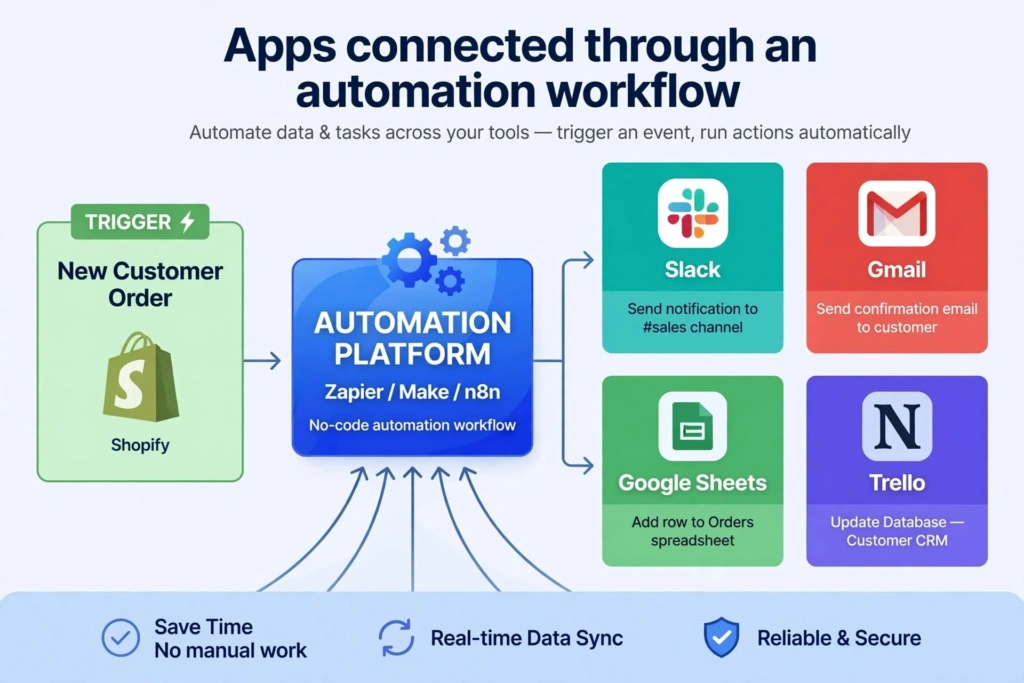
One of the biggest advantages of AI for startups is automation.
Zapier lets you connect different apps and automate tasks that you would otherwise have to do manually. For example, when someone submits a form, an automated workflow could send the information to another application, notify your team and create a follow-up task.
Startups can use automation for:
- Lead management
- Email notifications
- Customer onboarding
- Data entry
- Marketing workflows
- Sales follow-ups
- Internal notifications
Instead of manually moving information between different applications, automation can handle many routine steps.
Best for: Connecting apps and automating repetitive tasks.
6. AI Tools for Startup Sales: HubSpot
Getting customers is one of the biggest challenges for a startup.
HubSpot provides tools for managing contacts, leads, sales activities and marketing campaigns. Its AI features can help teams with tasks such as content creation, customer interactions and sales workflows.
A startup can use a CRM to keep track of:
- Potential customers
- Sales conversations
- Follow-ups
- Customer information
- Marketing campaigns
- Deals and opportunities
This becomes increasingly important as your customer base grows.
Best for: CRM, sales and marketing.
7. AI Coding Tools for Startups: Cursor

For software startups, development speed matters.
Cursor is an AI-powered coding tool that helps developers write, understand, edit, and fix their code more easily.
It can be useful when you’re:
- Building an MVP
- Fixing bugs
- Understanding unfamiliar code
- Creating new features
- Refactoring code
- Working with large codebases
AI coding tools don’t replace good developers, but they can reduce the amount of time spent on repetitive coding tasks.
Best for: Developers and technical founders.
8. AI Writing Tools for Startups: Grammarly
Good communication matters when you’re talking to customers, investors, employees and business partners.
Grammarly can help improve writing by identifying grammar problems, improving clarity and suggesting better wording.
Startups can use it for:
- Emails
- Blog posts
- Website copy
- Proposals
- Social media posts
- Customer communication
It’s a simple tool, but small improvements in communication can make a business look more professional.
Best for: Writing and professional communication.
9. AI Research Tools for Startups: Perplexity
Before launching a product, founders need to research markets, competitors, customers and industry trends.
Perplexity is useful for research because it gives you quick answers along with sources you can check for more information.
It can be useful for:
- Competitor research
- Market research
- Product research
- Industry research
- Finding relevant sources
- Comparing products and services
However, don’t blindly accept AI-generated research. Important business decisions should always be checked against reliable sources.
Best for: Research and information discovery.
10. AI Tools for Startup Meetings: Otter.ai
Startup teams spend a surprising amount of time in meetings.
Otter.ai can transcribe conversations and help turn meetings into searchable notes.
This can be useful for:
- Team meetings
- Customer interviews
- Product discussions
- Sales calls
- Research interviews
Instead of trying to remember everything discussed during a meeting, your team can refer back to the transcript and notes.
Best for: Meetings, interviews and documentation.
11. AI Marketing Tools for Startups: Jasper
Marketing is another area where startups can benefit from AI.
Jasper focuses heavily on marketing and content creation. It can help teams create and improve marketing copy for different channels.
Startups can use AI writing tools for:
- Blog ideas
- Advertising copy
- Landing pages
- Email campaigns
- Social media content
- Product descriptions
However, don’t publish AI-generated content without editing it. Adding your own experience, examples and brand voice will make the content more useful and authentic.
Best for: Marketing and content teams.
12. AI Project Management Tools for Startups: ClickUp
Managing multiple projects can become difficult when a startup grows.
ClickUp combines project management features with AI capabilities that can help teams organize tasks, summarize information and improve productivity.
You can use it to manage:
- Product development
- Marketing campaigns
- Content calendars
- Team tasks
- Deadlines
- Project documentation
The goal isn’t simply to add another tool to your workflow. The right project management system should make it easier for everyone to understand what needs to be done and when.
Best for: Project management and team productivity.
AI Coding Tools for Startup Developers
AI can help startups in several important areas.
1. Save Time
Repetitive tasks can consume hours every week. AI can help with writing, research, documentation, customer responses and other routine work.
2. Reduce Operational Costs
A small team can handle more work when the right AI tools are used effectively. This doesn’t mean replacing employees. Instead, AI can reduce repetitive workloads and allow people to focus on higher-value tasks.
3. Improve Productivity
When employees spend less time on repetitive work, they can spend more time on product development, customers and strategy.
4. Launch Products Faster
AI coding and design tools can help founders create prototypes and MVPs faster.
5. Improve Customer Experience
AI can help businesses respond to common customer questions, organize customer information and automate follow-ups.
How to Choose the Best AI Tools for Your Startup
Don’t choose an AI tool simply because it is popular.
Before paying for a tool, ask yourself:
What problem does this tool solve?
If the answer isn’t clear, you probably don’t need it.
You should also consider:
- Pricing
- Ease of use
- Integration with existing tools
- Data privacy
- Team collaboration
- Scalability
- Quality of AI output
Start with a small number of tools and add more only when your business actually needs them.
A Simple AI Stack for a New Startup
If you’re just starting, you don’t need 20 different AI applications.
A simple setup could look like this:
ChatGPT → Writing, brainstorming and research
Canva → Design and presentations
Notion → Documentation and planning
Zapier → Automation
HubSpot → Customer and sales management
Cursor → Coding, if you’re building software
This gives a startup coverage across many important areas without creating unnecessary complexity.
Common AI Mistakes Startups Should Avoid
AI can be powerful, but using it incorrectly can create new problems.
Using Too Many Tools
Having dozens of subscriptions doesn’t automatically make your business more productive.
Publishing AI Content Without Editing
AI-generated content can contain mistakes, generic statements or information that doesn’t match your brand.
Sharing Sensitive Information
Be careful about entering confidential customer, financial or company information into AI services. Always understand the data and privacy settings of the tools you’re using.
Replacing Human Judgment
AI should support decision-making, not blindly make important business decisions for you.
Final Thoughts on AI Tools for Startups

The best AI tools for startups aren’t necessarily the tools with the longest feature lists. The best tools are the ones that solve real problems in your business.
A founder might use ChatGPT for daily work, Canva for marketing, Notion for organization, Zapier for automation and HubSpot for managing customers. A technical startup may also benefit from an AI coding tool such as Cursor.
The key is to start small.
Choose a few tools, understand how they fit into your workflow, and measure whether they are actually saving time or improving results. As your startup grows, you can build a larger AI stack around your specific needs.
AI works best when it helps your team work smarter, move faster and spend more time on the things that actually grow the business.